Hm... that I would not have expected, but maybe I try it for maybe one minute and monitor the heat on the wire. That wire definitely doesn't look like gauge 10, which I would want to have for such high current. Ok, more troubleshooting required.
The oscilloscope shows a picture of what the voltage shape is. In the case of alternating current (AC) the voltage follows a sinusoid. The best example is the voltage you get on any outlet. They tell you it's 120 volts. But really, it is 120 volts RMS (root mean square). If you look with the oscilloscope at the voltage you get from the wall, you will see a picture like this below:
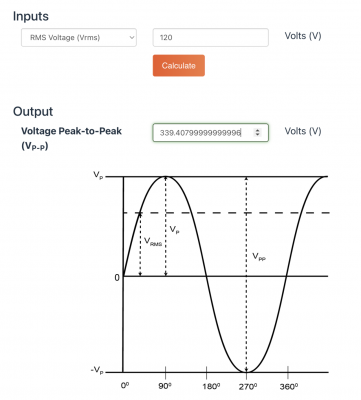
As time goes by, the voltage goes up to about plus 170 volts above ground, then it goes below ground to about minus 170 volts. And it does this 60 times per second. Which is why at the wall we say we have a frequency of 60Hz. So the oscilloscope shows you the picture like the drawing above. If for some reason the voltage would repeat some other shape, like square, the oscilloscope would show it to you. Same thing if the voltage would have drops to zero, and then sudden spikes to any voltage, plus or minus. A voltmeter cannot tell you this information. Most voltmeters cannot measure the RMS voltage; a voltmeter which can measure true RMS is expensive! Normal voltmeters are pretty good at showing direct current (DC) which, depending on how well it is filtered, it may show as a line on the oscilloscope. That means it stays pretty stable, like from a battery it would show a line at about 12 volts.
To charge a battery you need first of all a rectifier. The rectifier does not allow any voltage to go below zero volts (ground). So instead of the hill and valley you see in the above picture, you would see just hills that go up to some max voltage, then go down to zero, and from there jump up to another hill. This is what it would look like, and it's not yet filtered:
It is also not regulated yet. A voltage regulator is a more complicated circuit than a bridge rectifier, which is just four diodes. The voltage regulator job is to not allow the voltage get above some maximum value. To charge 12V batteries the ideal voltage is no larger than about 14 volts. So the regulator's main job is to cut all voltage that wants to go above 14 volts. A really good regulator will keep the charging voltage somewhere around 14 volts.
Now that's a ramble!!!!


 You got caught!


 I'm not sure. Thinking out loud, I suspect that each magnet is responsible for one sine wave as each induced some current through the wire/coil in the stator that passes by. If the magnets are somewhat equally distant around the flywheel, the waveforms overlap and you get a clear frequency and more current through the stator. If some magnets are moved significantly from where they normally sit, the frequency would change? And if missing, then it wouldn't provide much current? Basically I'm not sure.


