Page 2 of 3
Re: 644 charging system is not well
Posted: Wed Jun 01, 2022 10:26 am
by Eugen
Propane57 wrote: ↑Wed Jun 01, 2022 7:02 am
You got resistance some where in that B wire from the battery to the regulator. Could be the key switch. B terminal in the key switch are knowen to go bad. Any connection along the way could be the trouble too. And maybe wire size to small. Someone could have changed some or all of it over time. Battery must be fairly dead to show 15 amps. Bad connection along the way could be causing the voltage to jump around.
There now, a Wednesday ramble.

Noel
Noel, the battery voltage is about 12.5V, that rules out a good reason for the 15A draw. I agree that an intermittent connection somewhere would make the voltage jump all over the place, but not to 100V. Of course, this could be my voltmeter getting confused. I put my money on the regulator though. I ordered a replacement.
Thank you for the ramble, which is not a ramble, but very good troubleshooting ideas!!! You say you ramble but you know a lot!

You got caught!

Re: 644 charging system is not well
Posted: Wed Jun 01, 2022 11:29 am
by propane1
I’d say the voltmeter or where your connecting the voltmeter leads too, could be the trouble. In my 17 years of playing with garden tractors, I’ve rarely ever seen a bad regulator, or stator. And only one bad electric magnet pto bad. Normal things to go bad, I’ve found, are wiring, connections, key switches and operating switches. Just my take on it. Everybody has theirs.
Thanks for the nice comment Eugen.
Noel
Re: 644 charging system is not well
Posted: Wed Jun 01, 2022 11:48 am
by Eugen
But you did see magnets come off the fly wheel
This could be the problem, but for a very small cost I will rule the regulator out. Also, it's not a bad idea to have a spare one around. Because of my current situation, time is also a big factor in everything I do. Just wanted to rule out the regulator before I invest two hours of my time, which is very hard to get these days.
Also, I did mention that the oscilloscope showed a nice sine wave when connected directly to the wires that come from the stator. The peak-to-peak voltage seemed to be about 50 volts. 50 volts peak-to-peak is about 17.7 volts RMS, which sounds pretty healthy AC for charging. I have enough diodes or rectifier bridges around to just hook up and get DC, but then I'd have to also build a 25A voltage regulator which is not that simple. Simpler for me to throw 24 dollars at it, shipping included.

I could be wrong, but if some magnets have moved or fallen, I would not expect to see a nice sine wave.
Anyway, I thought I ruled out the easier problems, such as switches and wiring, but I could be wrong. I'm learning Noel, I'm learning. Luckily for me, you guys have a lot of experience and I got good teachers!

Re: 644 charging system is not well
Posted: Wed Jun 01, 2022 12:14 pm
by propane1
Yes I did see magnets on the flywheel loose once, and it’s a fairly common trouble, I’ve heard from others. Glues don’t last forever, so the possibility magnets falling off sure is possible. But what your finding with your oscilloscope, I would say the magnets are good. I have no idea how a oscilloscope works or what it tells you. Way over my head.
You say amp gauge was at 15 amps, did the amps start to reduce after running the engine a bit.? A battery maybe at 12.5 volts, but down on amps and would need a charge. Maybe, just guessing there. I know my YT16H Ford when it starts, the amp gauge shows 15 amps, but with in 30 to 60 seconds the amps start to drop to operating amps with the electric pto on to about 3 to 4 amps. If the battery was dead the amps would stay up longer.
Just another ramble.
Noel
Re: 644 charging system is not well
Posted: Wed Jun 01, 2022 1:09 pm
by Eugen
Hm... that I would not have expected, but maybe I try it for maybe one minute and monitor the heat on the wire. That wire definitely doesn't look like gauge 10, which I would want to have for such high current. Ok, more troubleshooting required.
The oscilloscope shows a picture of what the voltage shape is. In the case of alternating current (AC) the voltage follows a sinusoid. The best example is the voltage you get on any outlet. They tell you it's 120 volts. But really, it is 120 volts RMS (root mean square). If you look with the oscilloscope at the voltage you get from the wall, you will see a picture like this below:
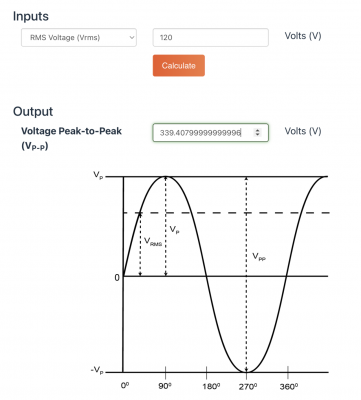
As time goes by, the voltage goes up to about plus 170 volts above ground, then it goes below ground to about minus 170 volts. And it does this 60 times per second. Which is why at the wall we say we have a frequency of 60Hz. So the oscilloscope shows you the picture like the drawing above. If for some reason the voltage would repeat some other shape, like square, the oscilloscope would show it to you. Same thing if the voltage would have drops to zero, and then sudden spikes to any voltage, plus or minus. A voltmeter cannot tell you this information. Most voltmeters cannot measure the RMS voltage; a voltmeter which can measure true RMS is expensive! Normal voltmeters are pretty good at showing direct current (DC) which, depending on how well it is filtered, it may show as a line on the oscilloscope. That means it stays pretty stable, like from a battery it would show a line at about 12 volts.
To charge a battery you need first of all a rectifier. The rectifier does not allow any voltage to go below zero volts (ground). So instead of the hill and valley you see in the above picture, you would see just hills that go up to some max voltage, then go down to zero, and from there jump up to another hill. This is what it would look like, and it's not yet filtered:
It is also not regulated yet. A voltage regulator is a more complicated circuit than a bridge rectifier, which is just four diodes. The voltage regulator job is to not allow the voltage get above some maximum value. To charge 12V batteries the ideal voltage is no larger than about 14 volts. So the regulator's main job is to cut all voltage that wants to go above 14 volts. A really good regulator will keep the charging voltage somewhere around 14 volts.
Now that's a ramble!!!!
Re: 644 charging system is not well
Posted: Wed Jun 01, 2022 2:30 pm
by propane1
You got that right Eugen. Just a great ramble. You might be the ramblin king.
Still over my wittle brain. But sorta understand. I remember the hertz thing. Many years ago in the first of electricity. It was 25 pulses a second in stead of 60. So It was slow enough that you could see that in light bulbs. So it was move up to 60 over time so you don’t see the little flashes in the bulb. That’s what I remember, could be wrong.
So, if a magnet was out of place or missing, there would not be a hill or wave on the scope. Is this correct.
Noel
Re: 644 charging system is not well
Posted: Wed Jun 01, 2022 3:11 pm
by Eugen
Propane57 wrote: ↑Wed Jun 01, 2022 2:30 pm
You got that right Eugen. Just a great ramble. You might be the ramblin king.
I am honoured to be in the company of such great ramblers!!
So, if a magnet was out of place or missing, there would not be a hill or wave on the scope. Is this correct.
Noel
now you really made me think!


I'm not sure. Thinking out loud, I suspect that each magnet is responsible for one sine wave as each induced some current through the wire/coil in the stator that passes by. If the magnets are somewhat equally distant around the flywheel, the waveforms overlap and you get a clear frequency and more current through the stator. If some magnets are moved significantly from where they normally sit, the frequency would change? And if missing, then it wouldn't provide much current? Basically I'm not sure.

Re: 644 charging system is not well
Posted: Wed Jun 01, 2022 8:14 pm
by MattA
Propane57 wrote: ↑Wed Jun 01, 2022 2:30 pm
You got that right Eugen. Just a great ramble. You might be the ramblin king.
Still over my wittle brain. But sorta understand. I remember the hertz thing. Many years ago in the first of electricity. It was 25 pulses a second in stead of 60. So It was slow enough that you could see that in light bulbs. So it was move up to 60 over time so you don’t see the little flashes in the bulb. That’s what I remember, could be wrong.
So, if a magnet was out of place or missing, there would not be a hill or wave on the scope. Is this correct.
Noel
Many years ago the generators at Niagara Falls were 25Hz. Parts of the electrified northeast corridor rail network are still 25Hz from the Pennsylvania railroad. The electric GG1 engines were still in service until late 1983 and used multiple tap transformers to control the speed of the engine. Nowadays the voltage conversion is done with electronics which allows the northeast corridor to have 25KV 60Hz, 12.5KV 60Hz and 11KV 25Hz sections without the need to change engines.
Back to Eugene's topic

Re: 644 charging system is not well
Posted: Wed Jun 01, 2022 9:50 pm
by Eugen
That is so neat @MattA !
As for the tractor, I just let it run for a while because I needed it, and the current draw did go down to about 8 amps. I'll show in the 680 thread what I used the 644 for.
Re: 644 charging system is not well
Posted: Thu Jun 02, 2022 6:50 am
by DavidBarkey
@Eugen Have you tried to remove the regulator yet ? If so is there a square hole in the tin work behind it ? If so it is on back wards . The fins are suppose to be in the air flow for cooling , but some older models surface mounted like that . Most surface passive air cooled regulator have much taller finns like this .