Page 1 of 2
How are you preheating?
Posted: Fri Jan 23, 2026 3:41 pm
by Toolslinger
Ok... If you're preheating your machine, how are you doing it? I use 3 - 200w magnetic heaters on my 8N's rear end, and it helps get the molasses my uncle insists on using flowing a little better...
I've got a couple more I could use on the 444. I did put one on the bottom of the block to help the engine. I'd love to stick something on the hydraulics, but with a plastic tank that's not real easy...
Thoughts? I thought about the steel line along the right side, but that's not a great location to stick a flat magnet...
Other than that, I'm ready for the storm...
Every tractor has it's chains on. The backup generator is in place. The backup, backup generator is in place. Firewood is restocked in the house, and I put a restock under the house. Beef is thawing so I can make chili tomorrow, and I have enough supplies to make a poundcake, and a couple batches of cookies. Have a new book to read if the internet goes down, but I also have backup cellular internet...
Re: How are you preheating?
Posted: Fri Jan 23, 2026 6:01 pm
by RoamingGnome
I wonder if a small battery blanket could fit around the plastic Hyd tank?
Or maybe something like this -
wrapped around the line to the oil cooler
- Just some random thoughts - trying to think outside the box...

My experience is more with bigger industrial equipment where we used inline coolant heaters for diesel engines or self adhesive stick-on heater pads on the bottom of engine oil pans and bottom of large hydraulic tanks.
For machines in remote locations - (like logging machines spending the night in the middle of the forest)
(-35°C (-31°F) Elk Lakes - BC/Alberta Border)
It was cold... and no outlets in the forest to plug block heater cords into.

I installed Espar diesel fueled coolant heaters - this was an interesting option because in addition to warming the engine you could tee a stainless line to go inside the hydraulic tank and warm the hydraulic oil with warm engine coolant- an operator could program the timer unit and show up at his machine at 6 am and the machine would be warmed up, ready to go when he got there
Re: How are you preheating?
Posted: Fri Jan 23, 2026 6:23 pm
by Toolslinger
That elbow wrap is interesting... I haven't seen that one before. I'll have to look in to that type more.
We use some silicone belts with heating wire in them at work to melt drums of solid (I believe) coconut oil, so it can be pumped out. They're a bit big for this application.
I have been threatening for years to put a coolant heater on my JD300 loader. Every winter I kick myself for having not done it again. I saw one that would probably even work for the 8N, but the engine isn't the issue on that machine, just the hydraulic sump/rear.
Re: How are you preheating?
Posted: Fri Jan 23, 2026 7:28 pm
by DavidBarkey
I use one of these on my tanks . <img src="
https://m.media-amazon.com/images/I/61j ... 500_.jpg"/>
They are metal tanks ,but do not why it would not work on the plastic tanks . My blower tractor is preheated before use . Usually only 15- 30 minutes to take the chill off .
Re: How are you preheating?
Posted: Fri Jan 23, 2026 10:00 pm
by MattA
Plastic has a very low thermal conductivity meaning it doesn't transfer heat well like metals do.
Re: How are you preheating?
Posted: Sat Jan 24, 2026 5:33 am
by DavidBarkey
MattA wrote: ↑Fri Jan 23, 2026 10:00 pm
Plastic has a very low thermal conductivity meaning it doesn't transfer heat well like metals do.
Yes true , But I think it would absorb some and being over the pump it would absorb some heat too . When really cold out it would help , especially if had a moving blanket over the hood to hold the heat in untill started . The older metal tanks are easier to work with for sure .
Re: How are you preheating?
Posted: Sat Jan 24, 2026 12:43 pm
by RoamingGnome
MattA wrote: ↑Fri Jan 23, 2026 10:00 pm
Plastic has a very low thermal conductivity meaning it doesn't transfer heat well like metals do.
Knowing what a PITA it is trying to find used tanks for these machines, and having burned fingertips when doing a quick "touch test"

(to make sure the pads were working on the underside of big hydraulic tanks) - I was worried about just how hot those pads would get if stuck on a plastic tank... I Googled the webpage for the Kat's Brand Silicone pad heaters...
 https://www.nickson.com/brands/kats-heaters/
" Will the silicone pad heater adhere to an aluminum oil pan?
Yes, the adhesive silicone pad heaters will stick to all smooth metal surfaces, including aluminum. However, the surface should be cleaned of any grease or oil to ensure strong adhesion. It's also important that the surface is warmed during installation.
Note: Pad heaters should not be used on plastic or composite materials."
" How hot do silicone pad heaters get?
Silicone pad heaters do not have a fixed temperature. The heat they generate depends on various factors, including the weather, ambient temperature, fluid capacity, wattage, and proper installation."
Unlike old fashioned circulation heaters commonly found on full size tractors and older autos - the silicone pads aren't temp regulated and rely on the thermal mass of whatever they are stuck to - to prevent overheating. Most circulation heaters have a built in thermostat that cycles on and off between 120° and 175°F
.
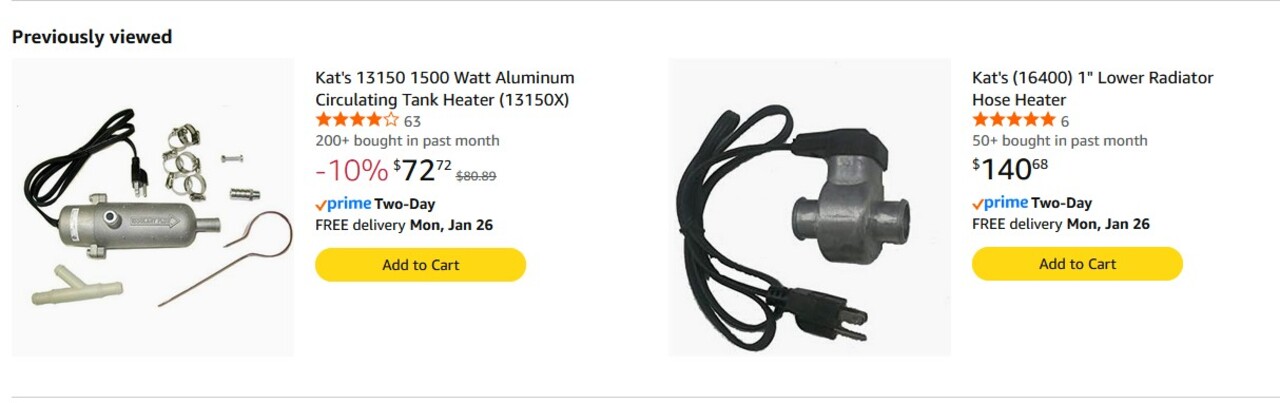
- circulation heaters.jpg (67.18 KiB) Viewed 7249 times
(and I learned the manufacturer doesn't recommend using circulation heaters on vehicles 1995 and newer... (if you could find room in the engine compartment)

I also learned something new to me though - hadn't seen a dipstick heater before...
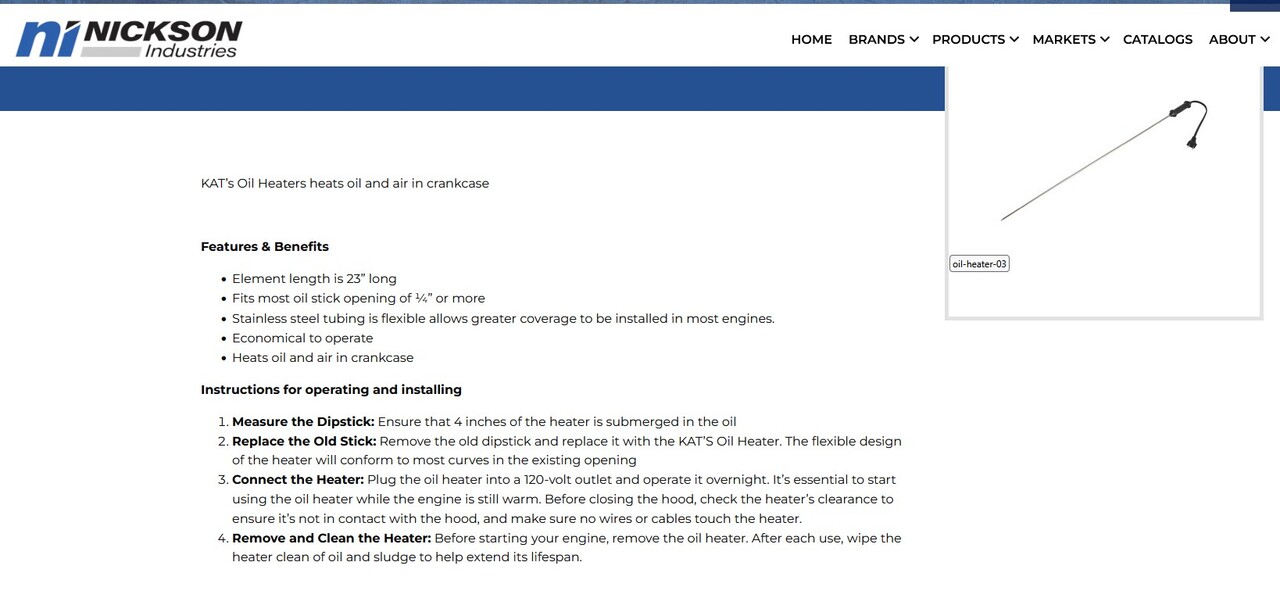
- oil heater.jpg (98.84 KiB) Viewed 7249 times
(Click on the photo to see the full screen shot)
Thanks
@Toolslinger - for a good distraction on a frigid Saturday morning - amazing the interesting things to discover when someone asks a question...

Re: How are you preheating?
Posted: Sat Jan 24, 2026 6:01 pm
by DavidBarkey
This is copied from the ones I listed . So some are thermically controlled .I am not saying to use on plastic tank unless you have a backup and are willing to experiment .
Smart Temperature Control Protection-Equipped with a built-in automatic constant temperature controller,our engine heater pad automatically powers off when the temperature reaches 194°F (90°C) and resumes heating when it drops below 122°F (50°C).This effectively prevents overheating risks and ensures safe use
I do not know what the high end operating temp of these plastic tanks are . Maybe Bob
@myerslawnandgarden knows .
something to think about
Re: How are you preheating?
Posted: Sat Jan 24, 2026 6:46 pm
by RoamingGnome
DavidBarkey wrote: ↑Sat Jan 24, 2026 6:01 pm
This is copied from the ones I listed . So some are thermically controlled .I am not saying to use on plastic tank unless you have a backup and are willing to experiment .
Smart Temperature Control Protection-Equipped with a built-in automatic constant temperature controller,our engine heater pad automatically powers off when the temperature reaches 194°F (90°C) and resumes heating when it drops below 122°F (50°C).This effectively prevents overheating risks and ensures safe use
I do not know what the high end operating temp of these plastic tanks are . Maybe Bob @myerslawnandgarden knows .
something to think about
Thanks for clarification
@DavidBarkey 
- the ones I installed in the Heavy Equipment shop 5-10 years ago were probably the cheapest possible ones they could source at the time and technology is always improving - they definitely didn't have the 2nd bump on the silicone pad like the ones in your picture (probably where the thermostat is located) - I too would be interested in knowing if there are any temp specs for the plastic tanks...
Re: How are you preheating?
Posted: Sat Jan 24, 2026 11:26 pm
by myerslawnandgarden
DavidBarkey wrote: ↑Sat Jan 24, 2026 6:01 pm
This is copied from the ones I listed . So some are thermically controlled .I am not saying to use on plastic tank unless you have a backup and are willing to experiment .
Smart Temperature Control Protection-Equipped with a built-in automatic constant temperature controller,our engine heater pad automatically powers off when the temperature reaches 194°F (90°C) and resumes heating when it drops below 122°F (50°C).This effectively prevents overheating risks and ensures safe use
I do not know what the high end operating temp of these plastic tanks are . Maybe Bob @myerslawnandgarden knows .
something to think about
You know, I don't have a hard number to give you, but just an opinion. I would definitely be careful applying heat to the plastic reservoirs as I often see them damaged just from overheating the oil during use.
A bit unrelated from your question, but useful knowledge... early production plastic reservoirs didn't have the metal inserts in the inlet and outlet fittings and if the oil temperature during use was high enough for the plastic to soften , the nipple would slightly collapse under the tension of the hose clamp and re-harden in the collapsed form resulting in a loosely clamped hose and a resulting oil leak.
Also, I've often seen the battery sink into the reservoir when the plastic softened enough under use. There is a metal reinforcement that holds the battery slightly above the reservoir for 3000/4000 series tractors, I highly recommend it.
Bob
