Page 7 of 14
Re: Adding a spool valve
Posted: Sat Nov 27, 2021 6:36 pm
by Jancoe
Well Bob once you get yours drilled out I'd be interested in another one. I have a 4016ps that I'd like to put pb on with integrated hold tcv. The pb is the best route to add hydraulic valves.. Let me know if you need any other measurements off it. I also think that making a a male jic end on the sleeve help with the frame space that we lack on them. It's tight there.
Sent from my SM-G975U using Tapatalk
Re: Adding a spool valve
Posted: Sat Nov 27, 2021 7:36 pm
by thebuildist
Absolutely. In all reality it'll probably be a month or more, but I'll be glad to. I'll keep everyone posted as to how it goes.
Bob
Re: Adding a spool valve
Posted: Mon Mar 07, 2022 11:52 am
by Everbreeze
Hi Bob, I just came across this thread recently while searching about adding power beyond to my 446 for auxiliary hydraulics. Machining the TCV for power beyond like the 600 series loaders are setup is an awesome idea. Have you made any progress lately? I'm sure there are a number of us who would gladly pay you for this service!
Re: Adding a spool valve
Posted: Mon Mar 07, 2022 12:49 pm
by Harry
Sorry I can't help you in your hydraulic dilemma. I'm not a hydraulic engineer and at my age not ready to start. I do know that on the 600 series tractors you can lift and curl the bucket at the same time.
Keep the Peace
Harry
Re: Adding a spool valve
Posted: Thu May 05, 2022 9:04 am
by thebuildist
Continuing here, this is really where it belongs:
thebuildist wrote: ↑Wed May 04, 2022 10:32 pm
Whelp, I took the plunge. The first step is to test the priority flow divider valve to see if I can find a happy adjustment.
In a nutshell, there are two paths I can take from here: either remove the TCV and modify it such that it has a power beyond port, and then feed the new loader valve from that power beyond port.
Or install the "priority flow divider" valve that I've already bought.
The TCV/power beyond option is fairly foolproof, in that it follows what Case did with the 646. All the oil leaving the TCV next heads to the loader valve for use in loader functions. But it's the most work, since I have to remove the TCV, completely disassemble it, do all the machining, clean out all the grit, and put everything all back together. And it's the most risk, as I could conceivably destroy my TCV by way of design error or machining mistake. (Not that I personally have ever goofed anything up, but I hear that it can happen to other people...

) The other downside is that the loader valve only gets pressure equal to the TCV's relief setting, in my case about 2100 psi. I think that 2100 is enough for what my loader needs, but just barely. As best I can calculate, my bucket tilt cylinders will need all of 2100 psi to tilt the bucket back with 1000lbs on the cutting lip. So I THINK it would be ok? But I'd rather have a bit of margin.
Meanwhile the priority flow divider valve would be a little easier to install. I just need to re-configure my new hard lines, both of them shorter than they are now. Working with hard lines is a pain, and I'm not happy to do it, but it's not as bad as reworking the TCV itself. And since it creates a completely separate circuit from the TCV, it can have a higher pressure relief than the TCV. Something like 3000psi seems reasonable. But the priority divider valve does have a potentially big downside: I don't know if its variable control is going to be granular enough to actually work in this application. It's rated for 20gpm, and I'm given to understand that these priority valves work best when operated near their rated flow. My flow at the divider valve is only about 9 gm. So my fear is that I may struggle to find a consistent workable sweet spot on the adjuster knob where the TCV is getting enough flow for normal operation, but there's still enough diverted for adequate loader operation. The adjustment knob reads from 1 to 10, and I'm afraid it may be a situation where a setting of "5" gives ALL the flow to the TCV, but then dialling it up a tiny bit to "5.1" suddenly cuts "all the flow" over to the loader valve and starves the TCV.
But there's only one way to find out for sure. So this morning, true to my decision, I pulled out the existing loader valve and piped in the new priority flow divider valve upstream of it. I ran out of time for today, so I didn't get to test it, but that'll be tomorrow's task: I have a loopback hose in place that routes all the oil from loader valve's "out" work port directly back into its "in" work port, and I'll drive the tractor around and see if I can find a setting on the priority valve's adjustment knob where I have "enough" flow to the TCV for workable driving, while simultaneously diverting "enough" flow through the loader valve.
Of course I'll have to judge the flow of the oil through the loader valve by sound, since I don't have an actual cylinder hooked up to it. But I at least ought to get a good sense of how "touchy" the divider valve adjustment is, and satisfy myself that there is a "wide enough" range of transition between "the TCV has all the flow" and "the TCV has zero flow."
I'll post back tomorrow with results.
Bob
It works!
I just took a quick drive, and the priority divider valve is sensitive enough to work. It's not perfect, but it's ok. It has a scale of 0 to 10, which I quickly figured out is "percent to priority" (the TCV is hooked up as "priority"). So a setting of "9" would divert 10% away and leave 90% of the flow for the TCV, while a setting of "2" would divert away 80%, leaving only 20% for the TCV. So you start at 10, (no diversion at all) and dial downward.
So my research was correct that it is a little touchy in this application. Driving at full speed (low range, I'm not a maniac

) I could dial it all the way down to about 7.5 before I could perceive any difference in how fast the tractor was moving. On down to about 6.5, the tractor was noticeably slower, but still fast enough that I'd consider it normal/usable. But move it down further to about 5, and the tractor stops moving at all. So the entire range of control is between about 8 and about 5 on the dial. Which doesn't surprise me, that's the lack of granularity/sensitivity I was given to expect.
But the good news is that I think it's still sensitive enough. I'll be able to leave the setting on "10" (no diversion) day in and day out, whenever the loader is detached. And when I hook up the loader, I just dial it down to about 6.5, and I can easily fine tune it as I'm using it.
I may yet find that there's no happy balance. It could still be that if I divert enough for the TCV, then the loader is too slow or vice versa. If that's the case, then it'll force me to go the TCV power beyond route. But for now, I'm going to proceed on this track. I think it's the best compromise available at this point.
Bob
Re: Adding a spool valve
Posted: Thu May 05, 2022 9:46 am
by Eugen
@thebuildist in my opinion your last worry is about going faster, even in LO setting. Given the type of loads you think you will carry with this tractor, if anything you'll want to be sure you don't go fast at all. I think another thing to worry about is the frame of the 400 series. I'd even worry about the 600 series frame if I routinely had to handle 1000 lbs. Therefore I'd think you'll be just fine with your current solution as far as the hydraulics go. Just my 2c
Re: Adding a spool valve
Posted: Thu May 05, 2022 10:38 pm
by thebuildist
so PART of the reason I've procrastinated so long is that I JUST CAN'T DECIDE which route I should go. I now have the oil drained and the newer hard lines removed.
And laying there looking up at it, it's awfully tempting to go ahead and convert the TCV to power beyond. The biggest challenge is that there is only about 1.9 inches of clearance coming out of the face of the power beyond port area. So my power beyond sleeve itself will have to be a swivel. There's not nearly enough room to come out with a straight fitting and then attach an elbow to that. I have an SAE10 to JIC10 swivel, and it sticks out 1.7 inches from the face of its sealing washer. So that swivel will fit between the TCV and the frame rail with a little less than 1/4" to spare. But I don't think you can get a wrench in there to tighten a fitting at that point, so I'll have to make an adapter to extend the PB output fitting by about 5 inches and angle back toward the center of the tractor. That'll put the next fitting joint in the fairly clear area to the right of and behind the TCV.
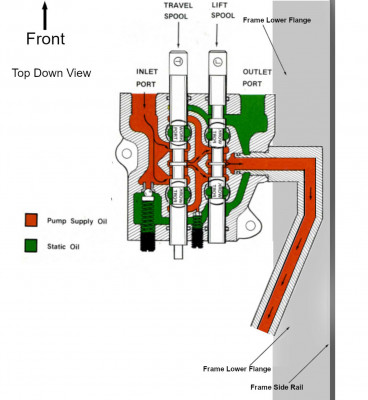
So I think I'm going to go for it. I think this is really the right way to do it, and I'd might as well do it right the first time, right?
I"ll be documenting the process as I go so I'll keep everyone posted with my progress.
Bob
Re: Adding a spool valve
Posted: Fri May 06, 2022 6:43 am
by DavidBarkey
@thebuildist Hey Bob , What about using a banjo fitting there ? They take up a lot less space . They work great for low flow high psi lines . They can be made to swivelled on o rings or fixed between sealing washers .
Dave
Re: Adding a spool valve
Posted: Fri May 06, 2022 11:10 am
by thebuildist
I like your out-of the box thinking. But I don't think there is quite enough end-wise clearance to insert and remove the banjo bolt with the TCV bolted in place. Researching banjo fittings I find that the one I'd want to use is either 43 or 40mm length, not including the head. So you could probably install and tighen it before you but the TCV in place, but once the TCV is in place, you can't unscrew the banjo bolt. Which puts it in the same bucket as I'm currently looking at.
I do agree it would look more conventional and workman-like, though. Of course, I could install the standard #10 swivel and just attach a hose to it before I bolt the TCV in place. And that would look cleaner and more conventional. But then to replace that hose, you'll have to remove the TCV. And since hoses have a relatively short service life, I'm wanting to go with something that's a: all steel and b: accessible with the TCV in place. That's going to look a little wonky, but only to those who are willing to remove the deck and lay down underneath the tractor.

Bob
Re: Adding a spool valve
Posted: Sun May 08, 2022 9:57 pm
by thebuildist
I've got the valve out of the tractor. Now it's time to go ahead and machine the bore and threads into it. Advice question: I've got both spools out of it currently, as well as the pressure relief valve. I haven't disassembled the holding valve portion, as I don't really know what to expect when it comes apart, and I'm not sure if there is some kind of adjustments that I'll struggle to reset when I'm done.
So I'm tempted to at least consider packing the spool valve chamber with damp gauze before I start machining, in order to try to keep the swarf and shavings from travelling deep into the valve. The idea would be that I could potentially avoing removing the holding valve internals at all.
Part of me thinks that's delusional. That I simply must strip the valve down to its bare iron housing, machine it, clean it all out. Then clean it out again. Then clean it out AGAIN. Then reassemble it.
Meanwhile, I've got a shiny new 7/8-14 tap created, next step is to make the reamer I'll need to cut the flat face and bevel where the SAE 10 o-ring will seal. I need to have all my tooling ready to go, because I won't have the mill available for toolmaking once I have the valve body all installed and aligned in position.
So what are everyone's thoughts: Should I tear out the guts of the holding valve or leave it in place for machining? Is the gauze packing idea crazy? What cleaning out methods would people recommend for after the machining is complete?
Bob