We're in the home stretch!
As of yesterday, the bucket is mounted. Not much to tell, I finished off in the direction I started. This time I flattened out the correct protrusion and ran a whole lot of weld bead.
Then ran a couple pieces of 4"x1/4" angle iron vertically at the back corners to carry the twisting forces up to the top of the bucket, because the quick-attach plate itself is mounted pretty low.
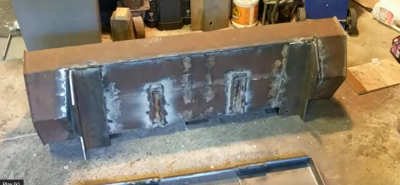
Then I drove the tractor up on 1.5" high boards, put the bucket flat on the floor, snugged the bucket up tight against the quick-attach plate, and tack welded it in place. I'll be welding a 1/2" hardened cutting edge underneath the current cutting edge. That extra 1/2" depth, combined with the tractor being 1.5" up in the air will give the bucket a 2" below grade cutting level. At full height it sits at 5'8" when it's level. I'm slightly underwhelmed by that figure, I had hoped to lift higher than the 5'11" of a stock 644. But all things told I chose the geometry I did for the best sense of strength and safety and good judgement. So I can live with it. If I built a second loader, I could start with this exact object and improve it. But working from a set of drawings created by nothing but my imagination, I'm still pleased with it.
Having said all that, it's not quite true to say "it's mounted." It's wasn't fully mounted, because the quick-attach bracket on the tractor didn't yet have locking pins installed. So if you back-dragged with it, the bucket would come off. That would be inconvenient.
So today I built and created the quick-attach locking pins.
I wanted a hardened pin, so I cut up the super hard shaft of a chisel from an electric jackhammer. I welded that pin to some 1" threaded rod. The idea is that turning the threaded rod will cause the pin to extend and retract.
I wanted the pin to have a large surface to bear against, so I drilled a matching hole through some 1" steel plate.
Then I used a piece of 1" black pipe as a spacer and welded the plate, spacer and 1" nut into a single assembly. Then I threaded/spun in the pin and welded a cheap socket on the end of the threaded rod, so that a 3/8 square driver can turn it.
Then I took some 7/16" rod and bent it into a speed handle. I ground a 3/8 square on one end, and now it's the driver tool to spin the pins in and out.
Finally I welded the pin assemblies in place. While I had the welder and tools out, I went ahead and welded some tabs and a spring in place on the back side of the quick-attach bracket, and that provides a way to mount the speed handle for storage. So though it's not great to have to use a tool to change quick-attach implements, at least that tool is permanently attached near where you need it.
So I'm down to 3 items: Weld on the new cutting edge, paint the bucket, and build a concrete counterweight.
Bob


